
Per Aspera Ad Culmen
Sisyphus Rests

“From Adversity, to the Summit”
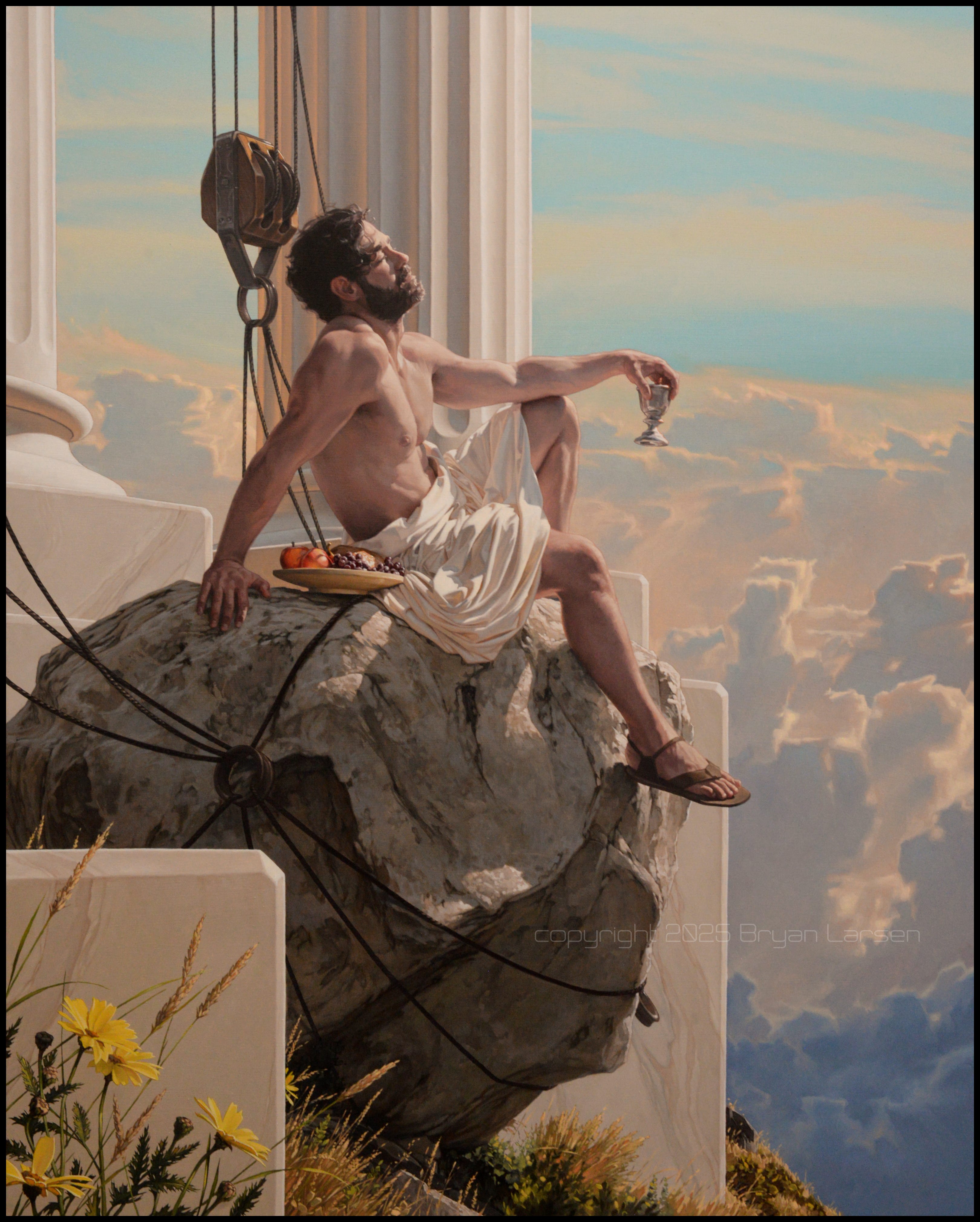
“Mine is a story of upward mobility” is how I began my introduction to Bryan Larsen through the webform on his site. I was approaching 50 and reflecting on the happiness I’ve found in my life despite my humble beginnings. I wanted to do something to celebrate my achievement. I had the idea to commission a painting. I’m no artist so I had no idea how to visualize the theme, but I at least had a title in mind that could capture it: Sisyphus Rests.
Sisyphus isn’t supposed to get the boulder to the top of the mountain so it would run counter to the usual narrative to see him succeed in his task. I wanted the struggle to be visible somehow, but the fact that it is over to be apparent. I wanted to see him enjoying his new circumstance in his own way—not as some exaggerated exultation—but more of a quiet reverie.
Larsen was excited by the prospect. His own spin on it is that Sisyphus should outsmart the gods through the use of his mind as opposed to raw muscle.
My Upward Mobility
To put some context on this, my beginnings were challenging. My mother was not quite an adult herself when she had me and my father was absent. We moved often and she took whatever jobs she could to make ends meet. When my sister was born, things got harder.
I was not well-behaved and barely interested in school. While I made poor grades, I spent a lot of my time reading on my own. It’s not that I wasn’t learning, it’s that I didn’t really care about doing the class work or passing the tests.
By the time I left home at 17 I had failed 2 grades. I never completed the 10th grade. I had no money, no car (or driver’s license), and a slightly above minimum wage job at McDonald’s 9 miles from my home. I had to get up at 3:30 AM to ride my bike to my job and then back home at the end of my day. I lived in a trailer, confining myself to the living room in order to save money on heat.
I eventually moved to a better neighborhood a little closer to my job. While I didn’t have any money, I did have friends. My friend David would sometimes see my riding my bike in town, pick me up, and take me home. There was one summer when almost every day we’d go to Taco Bel and rent movies, mostly on his dime. Another summer we would spend almost every day at my friend Regula’s playing pool in her basement. David & Regula later married and are still my friends today.
George & Dot were a retired couple that I met who helped me get my driver’s license and my first car. They kept pushing me to go to school and do something with my life. They provided advice, love, and nurtured me as best they could. They provided occasional financial assistance in emergencies, and made sure the point it out when they thought the emergency was self-created. They made it clear that if I ever experimented with drugs then that would be the end of our friendship. I never did.
I had other friends and mentors along the way—Ted, Marilyn, Scott—who helped me in one way or another. I remember and am grateful to them all. Where possible, I have made sure they know it.
I migrated from one low-paying job to another. I was a McDonald’s janitor, a machine shop janitor, a chemical plant laborer, a barista in the Starbucks Cafe portion of a local Barnes & Noble, a Burger King breakfast manager, and a line worker at a plastics recycling factory.
I was rather stupid with money. I got my first credit card when I was 17 and bought a guitar I couldn’t afford. Once I’d done that I was given many more credit cards which I promptly maxed out buying more stuff I couldn’t afford. By the time I was 23 I had more credit card debt than my annual salary. It really looked like I was a loser going nowhere fast.
But I also had something else—a fundamental conviction that I’d held all my life that circumstances can be better and that it is within my power to make them better. I didn’t know how to improve, but believed it was possible to do so and that it was my responsibility. I would persist in trying.
The Breakthrough
I knew I wanted to go to back to school. I’d tried school before but I lacked focus and discipline so it ended up being a waste of time. At this point though I knew what I wanted to do. I’d read newspaper articles about high school kids making $50K a year building websites—this was during the first internet bubble. At the time, this was an unimaginable sum of money to me. With that kind of money I could pay off my debts and never worry again! I had to learn this software thing.
Difficulty: I was working in the plastics factory and my schedule was 12 hour shifts, 4 days on, 3 off, then 3 days on and 4 off. Rinse and repeat on the night shift. Then back to days, etc.. This is not the sort of schedule that allowed for taking regular classes.
The machines in the factory made tiny plastic pellets that could be melted down and put into injection molds to make different kinds of products. The pellets were blown through air tubes through the factory into one of four enormous silos. My job was to drop the product out of the silos into two-thousand pound boxes and place those boxes into the warehouse for shipping. The factory runs 24/7, but you can drop a silo in an eight-hour shift. If you fail to drop the silo, the pellets will blow out all over the factory floor and have to be reprocessed.
I proposed to the manager that I set my own schedule. I would commit to keeping the silos drained, but would leave work to take classes when I needed to. So long as I got my hours in and the product kept moving from production to the warehouse, no one really needed to care about my schedule. The manager agreed and I got to work.
I took classes in C, C++, Operating Systems Fundamentals, and Visual Basic from the local technical college. Some of my days were 16 hours of work and school before I got back home at night. In my naivete I thought I was ready to start applying for jobs so I put my resume up on the college job board. And I got a call back.
And I got the job! It was April of 2000 when I went to work in an office for the first time. I was 25 years old. I understand now how unlikely this outcome was, but it’s still true that if you don’t A-S-K you don’t G-E-T.
In retrospect it was a terrible job. The company was run by three brothers with no qualifications other than that one had been friends with a rich kid and was known by the rich kid’s father. The brothers fought amongst themselves constantly. At the time though, I thought the job was amazing. I was so happy to be there! I had air conditioning and sat in a comfy chair all day and my clothes were clean when I went home!
Ben, my manager, was patient and encouraging. He had a background in teaching knew exactly how to feed me right-sized challenges so that I could productive. We are also still friends today.
And I learned.
I stayed in that job for almost three years before I took my next role. Everything felt precarious. I had no degree and limited experience. I wasn’t sure I could stack up against the other engineers who had degrees. I wasn’t sure I could be competitive. If I couldn’t stay in this work, I would have to revert to low-wage jobs in factories again. In my evening hours I read everything I could about the building software. I took work home and I practiced writing my own software for various purposes.
I lost a job for low-quality work in 2003. I started reading everything I could about ensuring quality in software. This would come to define the course of my career. I would be “the quality guy” from then on.
Fortunately, I found another opportunity fairly quickly. I think it had something to do with saving them $40K in the interview by telling them about an upcoming free product they could leverage instead of buying an expensive vendor product. This was when things really changed for me. I was working with other engineers who had both more education and more experience than me, but within a couple of months they were coming to me asking me how to do things. I didn’t realize it yet, and it would take a few years for me to get comfortable with this verbiage, but I was a leader.
During this time I was also negotiating settlements with my credit cards. I didn’t have the money to pay them in full so I worked with them to find ways settle the debt. I did not want to file for bankruptcy. My credit was ruined but I saw that as a positive—I couldn’t be trusted with credit yet so having no access to it would force me to learn some financial discipline. My debt was fully dissolved by 28. I bought my first house at 30. I finally finished my degree at 35. I kept that first guitar I bought. I never bought another one until I could pay cash for it.
Today
Fast forwarding a bit, as I became more respected in my field, my earnings went up. I became known as a software quality advocate on my teams. I re-established my credit worthiness. I eventually moved to Seattle to find better job opportunities. There I met Virginia, a lovely woman who would become my wife. I have maintained my friendships and developed new ones along the way.
As of this writing, I work for Meta. With 3.5 Billion people using Meta’s apps each day, they have the largest customer base in the history of the world. There are no off-the-shelf software solutions that can handle that kind of scale. The challenges are unique and interesting.
I no longer worry about my prospects. At work I’m still the quality lead and have a reputation for “getting shit done.” I like to solve hard problems that other people are afraid to touch. It seems like there’s always a market for that.
Early in my career I was afraid of losing it so I spent a lot of my free time honing my professional skills in my after-hours. These days I spend my free time on my hobbies. I love reading, tv, movies, musical instruments, video games, quality scotch, and smoking delicious, tasty meats. I find time for all of them. My life has transitioned from trying to make ends meet, to trying to establish a career I could rely on, to simply enjoying my relationships and my hobbies. Meta keeps me plenty challenged and I enjoy my work, but I’m looking ahead now to what I want to do in retirement which feels closer than I would have thought possible in my younger years.
Everything about my life is better than I would have thought possible in my younger years. On the one hand I can explain and understand every individual choice and step I took to reach where I am. On the other, when considering my start vs. my current state, it feels incredible. This is what motivated me to want to commission the painting in the first place. Like Sisyphus, I was not expected to end up where I am. Armed with the conviction that life can be better and with persistent effort to make it better, I got here anyway. And like the Sisyphus in the painting, it was the use of my mind that helped me “outsmart the gods.” And like him, I’ve earned the right to relax. To rest.
And I do—like a champ!
Back to the Painting
The most important question Larsen asked me during our first phone call was “Where do you want to hang it?” Will this be in a public space, or a private one?
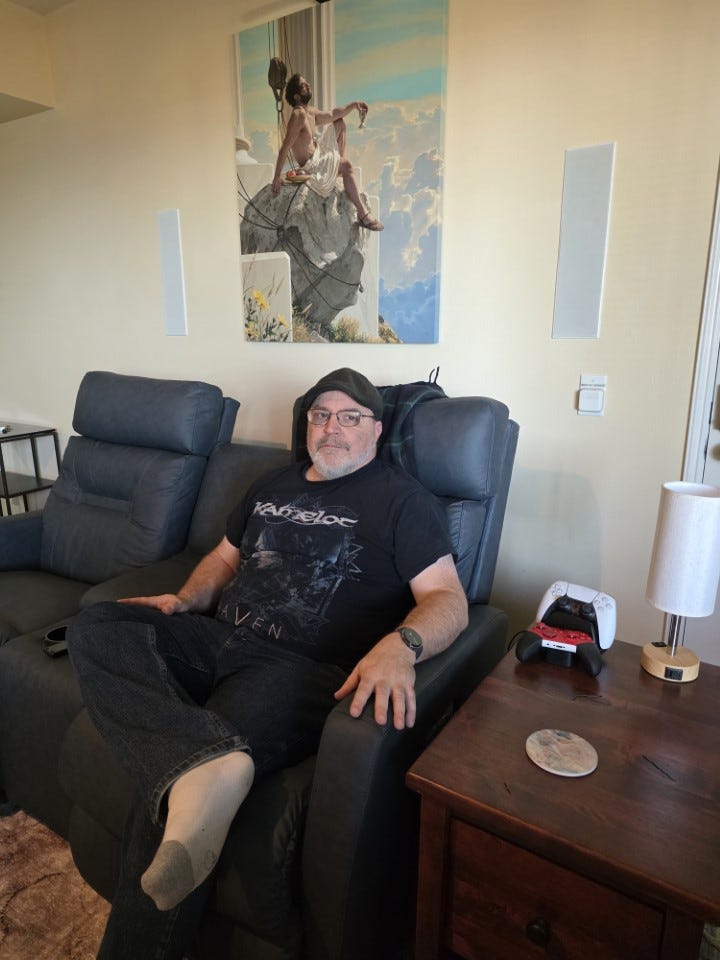
My answer: “Well, the way my wife and I have designed our home, she has the upstairs and I have the downstairs. The downstairs is where I keep my guitars, my scotch collection, and my home theater. It’s where I do my resting. I want it to be there for my friends to enjoy when they visit me.”
”Oh I like this,” he said “So the painting’s theme is universal—anyone can understand it. But the painting is not of you, but it is about you. And it will hang in the space that it symbolizes.”
Yes. Perfect. I have hired the right person for this project.
From there we started discussing the composition.
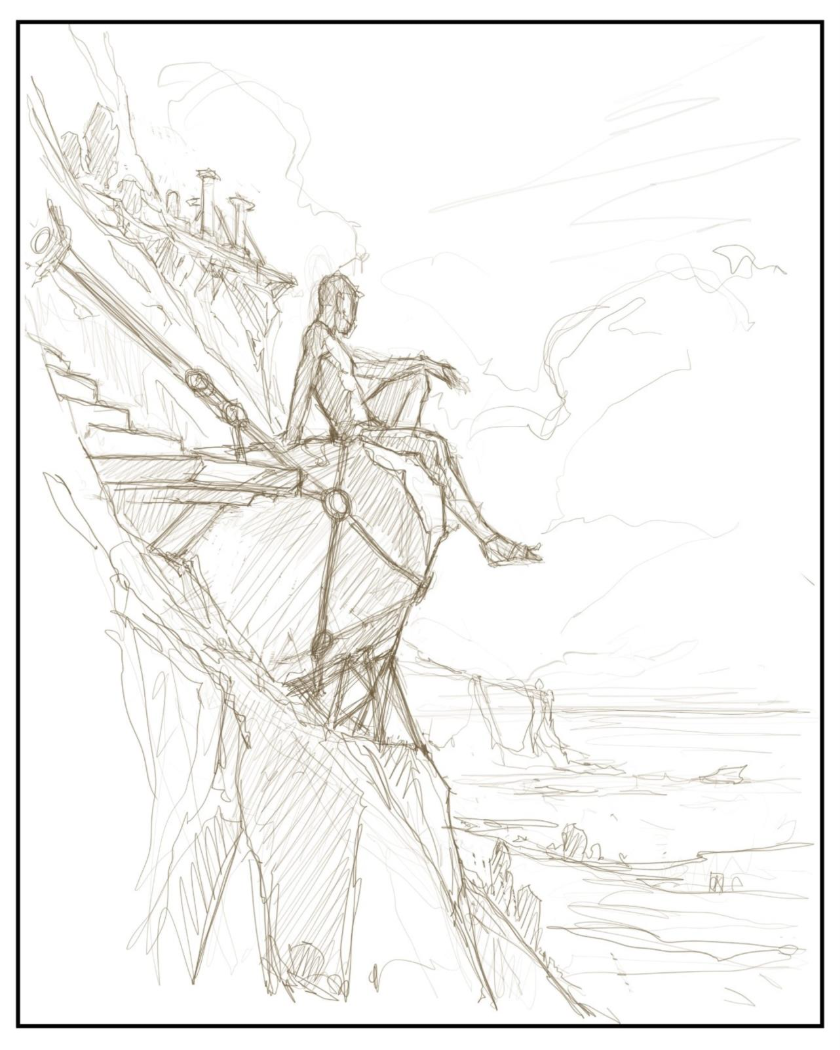
Above is one of the early sketches that Larsen shared with me. I like it, but in this image the work moving the boulder is in progress. I wanted to catch the later moment when the work is done. The winch and pulley system is great. The cables are like the nerves in the body—under tension when work is being done. I thought this would be a great way to bring that feeling of a great effort having been done in the past.
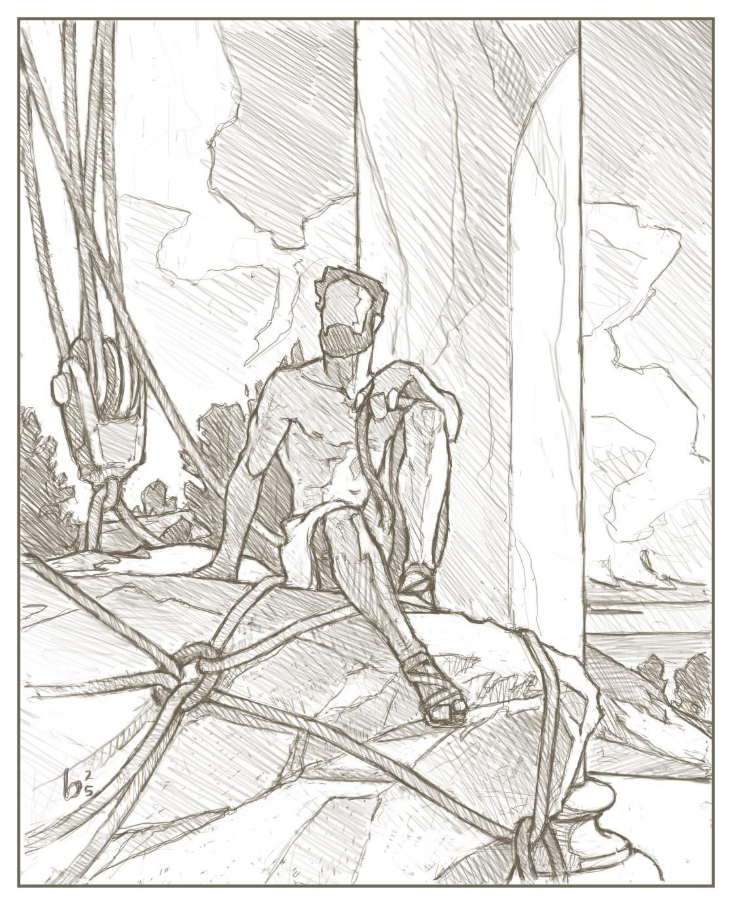
This sketch is much closer to what I wanted. You can see the slack in the ropes and easily imagine them under recent tension. It’s not as clear to me though that the effort is over. I like the addition of the columns in the background that imply some new project has been started, that Sisyphus has moved on from the boulder to other things.
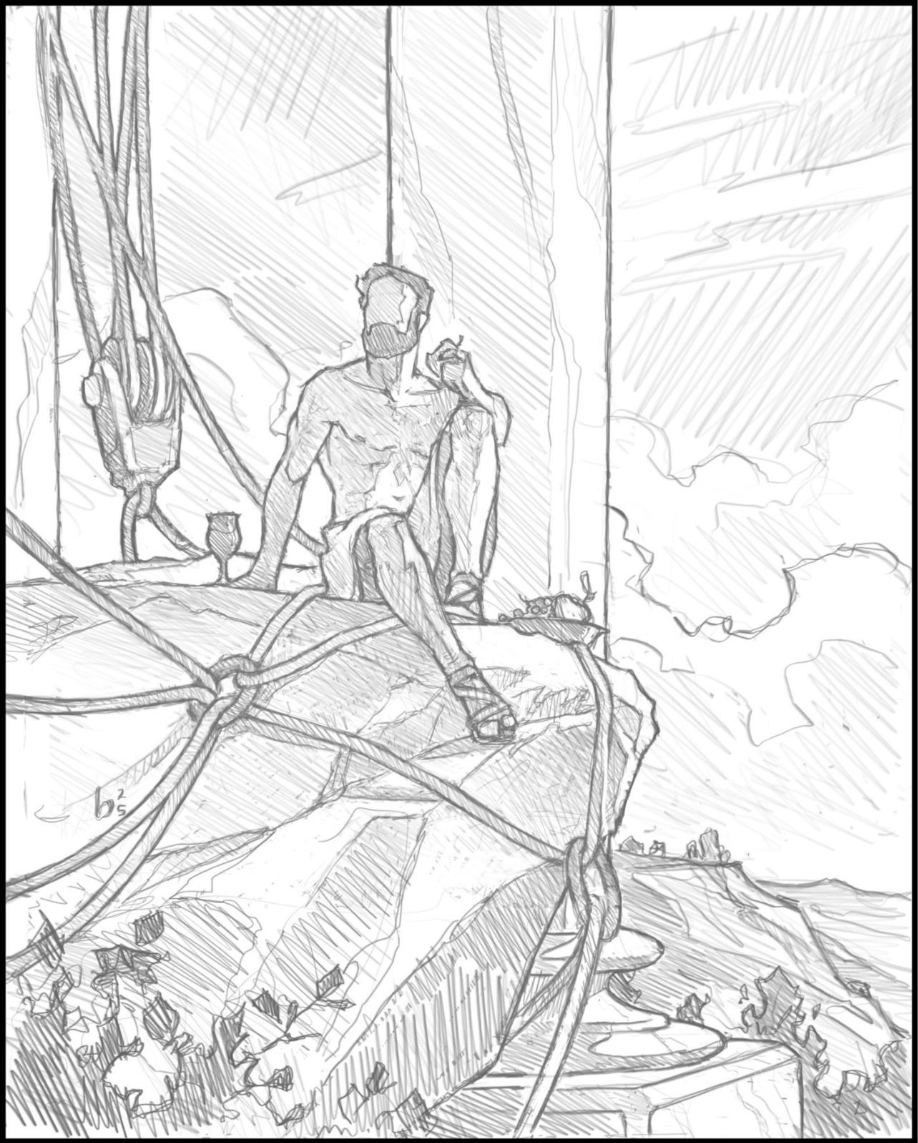
This was the final sketch we agreed on prior to finding a model. The columns are more pronounced, and the vegetation growing around the boulder show the passage of time since the labor was completed. The feeling of relaxation is given the enjoyment of food and wine.
More than one friend suggested that he should be drinking scotch. Fair enough, but it doesn’t match the other thematic elements. I found myself repeating Larsen’s summation in response: “It’s not of you but it is about you.”
How the Model Changed the Composition
When Larsen hired the model, he was having difficulty with the pose as presented in the latest sketch. It wasn’t quite natural and was hard to hold. It was a hot sunny day and he needed a break, so he sat slightly back, resting his upper body weight on his one arm behind him, face toward the sun… relaxed. Larsen took the opportunity to snap a photo. “What about this as the pose?”
Yes. It supports the theme equally well. Perhaps even better since the focus is own Sisyphus as opposed to what he might be looking at. Just Sisyphus, in the space, enjoying it.
Working With Larsen
Bryan Larsen was just amazing to work with. He sent me many sketches and took note of my responses. I felt totally free to say what was and was not working for me in each sketch. He let me know when something wouldn’t work—for example, I had toyed with the idea of including Tantalus and Atlas in the background somewhere. We spoke on the phone to get to know each other a little better and to make sure he fully understood the theme I was going for. The major compositional elements were his ideas which made it easy for me to make minor suggestions to make the theme sharper. At every step he checked in with me about his ideas—”I like this variation, but I want to make sure that you feel the same way.”
5/5 stars. Recommended.
I had no idea of your origin story. Thank you so much for sharing it!
Fascinating. How exactely did Sisyphus outsmart the gods using his mind, not muscle?